
 Weight Loss
 Injury and Repair
 Muscle Building
 Anti-aging
 Cognitive Function
 3ml Benzyl Alcohol Bacteriostatic Water
 Starter Pack
 Retatrutide Starter Bundle
 5-Amino-1MQ Dosage Guide (5mg)
Peptide Guides
How to Reconstitute Research Peptides: Complete Step-by-Step Guide for 2026
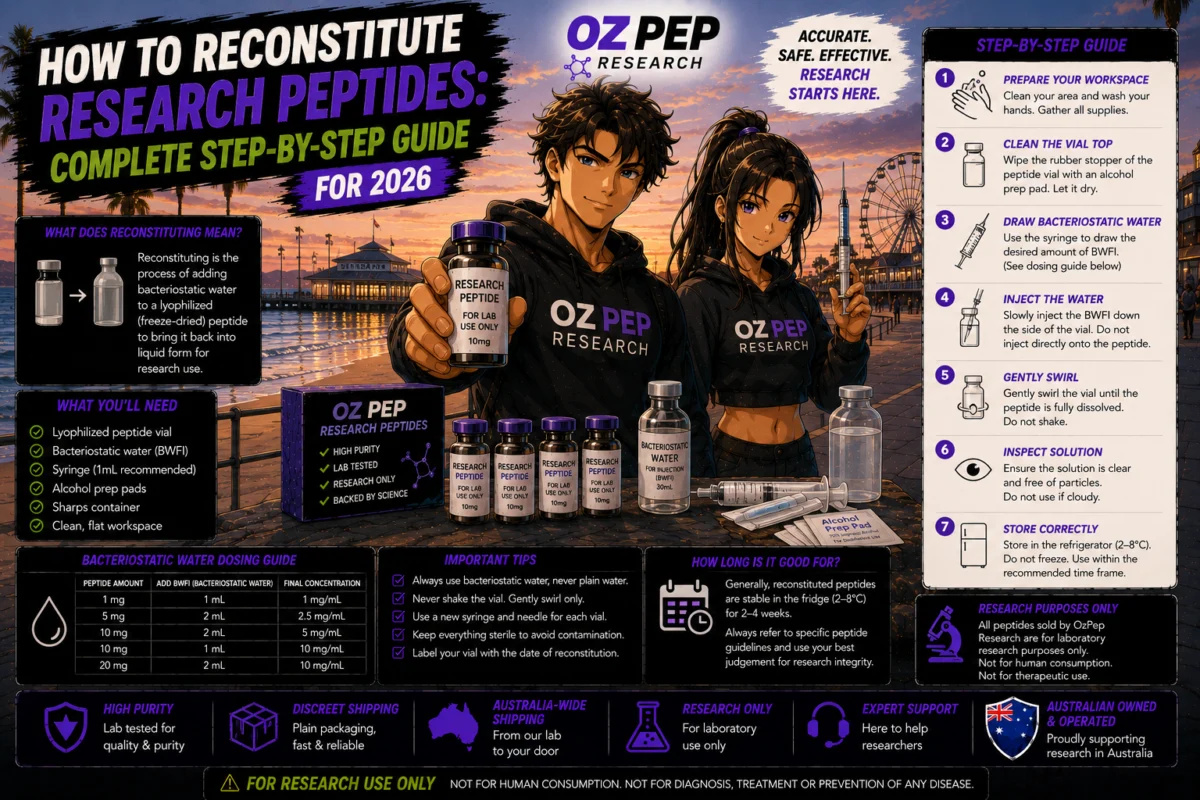
Key Takeaways
- All research peptides from verified suppliers are supplied as lyophilised (freeze-dried) powder and require reconstitution with bacteriostatic water before use.
- Use a sterile insulin syringe to slowly inject BAC water down the inner vial wall, then swirl gently — never shake vigorously.
- Store reconstituted research peptides at 2-8°C (refrigerated) and use within 28 days for maximum stability.
- Standard BAC water volumes: 1-2mL for 5mg vials, 2mL for 10mg vials, 2-3mL for 20-30mg vials.
- Proper reconstitution technique is critical — mistakes like shaking, using the wrong water type or improper storage can degrade peptide integrity.
You’ve got your research peptides delivered. They’re in pristine lyophilised form, sealed under vacuum, properly labelled. But before any research can begin, there’s one critical step standing between you and your protocol: reconstitution.
Get this wrong — use the wrong water, shake too hard, miscalculate your concentration — and you compromise the entire research programme. This guide walks you through every step of proper peptide reconstitution with the precision your research demands.
What Is Reconstitution and Why Does It Matter?
Research peptides are almost universally supplied as lyophilised (freeze-dried) powder. This isn’t accidental — it’s essential for stability:
| Form | Stability | Shelf Life | Shipping |
| Lyophilised powder | High (room temp stable) | 12-24 months | Ambient (no cold chain required) |
| Reconstituted liquid | Moderate (requires refrigeration) | ~28 days | Cold chain (2-8°C) |
Lyophilisation removes water content, preventing hydrolysis and microbial growth. The peptide remains inert and stable until you’re ready to reconstitute it.
Reconstitution is the process of adding sterile liquid (bacteriostatic water) to dissolve the lyophilised powder into a measurable, workable solution. Once liquid, the peptide becomes susceptible to degradation — which is why proper technique and storage are non-negotiable.
What You Need Before Starting
Essential Supplies
All supplies are available in our research supply collection” (or specific category page if exists)
| Item | Purpose | Specification |
| Bacteriostatic water (BAC water) | Reconstitution solvent | 0.9% benzyl alcohol preserved |
| Insulin syringes | Measurement and administration | 0.3-1mL, U-100, 29-31 gauge |
| Alcohol swabs (70% isopropyl) | Sanitisation | Individually packaged |
| Sharps container | Safe needle disposal | Approved medical waste container |
| Refrigerator thermometer | Temperature verification | Confirms 2-8°C storage |
| Vial labels/marker | Date tracking | Permanent marker or printed labels |
Critical: Use Bacteriostatic Water — Not Sterile Water
| Water Type | Benzyl Alcohol | Use for Peptides? | Why/Why Not |
| Bacteriostatic water | 0.9% | ✅ Yes | Inhibits bacterial growth; peptide stable 28+ days |
| Sterile water for injection | 0% | ❌ No | Bacterial growth risk after 24 hours |
| Sodium chloride 0.9% | 0% | ❌ No | Can affect peptide solubility; no preservation |
| Tap water | N/A | ❌ Never | Non-sterile; contains minerals and contaminants |
The 0.9% benzyl alcohol in bacteriostatic water is what makes multi-dose vial storage safe. Without it, bacterial colonisation becomes a significant risk within 24-48 hours.
Step-by-Step Reconstitution Protocol
Step 1: Preparation
- Wash your hands thoroughly with soap and water
- Sanitise your work surface with 70% isopropyl alcohol
- Remove peptide vial and BAC water from refrigeration 5-10 minutes before use (reduces condensation)
- Inspect the lyophilised powder — it should appear as a white, fluffy cake or powder. Do not use if clumped, discoloured or showing moisture
- Gather all supplies within easy reach
Step 2: Sanitise Vial Tops
- Open an alcohol swab
- Wipe the rubber septum (top) of the peptide vial with firm circular motions for 10-15 seconds
- Wipe the rubber septum of the BAC water vial using a fresh swab
- Allow both to air dry completely — do not blow on or touch the sanitised surfaces
Step 3: Draw Bacteriostatic Water
- Remove insulin syringe from sterile packaging
- Draw air into the syringe equal to the volume of BAC water you’ll withdraw (e.g., draw 2mL of air for 2mL of water)
- Insert needle through BAC water vial septum
- Inject the air into the vial (creates positive pressure for easier withdrawal)
- Invert the vial and withdraw your desired volume of BAC water
- Remove needle from BAC water vial
Step 4: Add BAC Water to Peptide Vial
This is the critical step where most mistakes happen:
- Insert needle through the peptide vial septum
- Direct the needle toward the inner glass wall of the vial — not directly at the powder
- Slowly inject the BAC water so it runs down the inside wall of the vial
- The water should gently contact and absorb into the lyophilised powder without forceful spraying
- Remove the needle once all water has been injected
Why the wall matters: Spraying BAC water directly onto lyophilised powder can cause “shear stress” that potentially degrades delicate peptide bonds. Running it down the wall allows gentle, gravity-assisted dissolution.
Step 5: Dissolve (Swirl — Don’t Shake!)
- Let the vial sit for 1-2 minutes to allow initial wetting
- Gently swirl the vial in small circular motions — think “wine glass swirl,” not “cocktail shaker”
- Continue swirling for 30-60 seconds until all visible powder is dissolved
- The solution should be clear — slight cloudiness may occur with some research peptides but should clarify within minutes
- Never shake vigorously — this causes peptide chain fragmentation and aggregation
Step 6: Verify and Label
- Inspect the solution for particulate matter — do not use if particles are visible (may indicate contamination or incomplete dissolution)
- Confirm the solution is clear to slightly opalescent
- Label the vial immediately with:
- Peptide name and concentration
- Reconstitution date
- Expiry date (28 days from reconstitution)
- BAC water volume added
- Store at 2-8°C (standard refrigeration) immediately
Concentration Calculation Guide
Accurate concentration calculation is fundamental to research dosing. Here’s how to work it out: For instant, error-free calculations, use our Peptide Reconstitution Calculator.
The Formula
Concentration (mg/mL) = Total Peptide (mg) ÷ Total Volume (mL)
Common Reconstitution Examples
| Peptide Vial | BAC Water Added | Resulting Concentration | Volume per 1mg Dose |
| 5mg | 1mL | 5mg/mL | 0.2mL (20 units on U-100) |
| 5mg | 2mL | 2.5mg/mL | 0.4mL (40 units on U-100) |
| 10mg | 1mL | 10mg/mL | 0.1mL (10 units on U-100) |
| 10mg | 2mL | 5mg/mL | 0.2mL (20 units on U-100) |
| 10mg | 3mL | 3.33mg/mL | 0.3mL (30 units on U-100) |
| 20mg | 2mL | 10mg/mL | 0.1mL (10 units on U-100) |
| 20mg | 3mL | 6.67mg/mL | 0.15mL (15 units on U-100) |
| 30mg | 3mL | 10mg/mL | 0.1mL (10 units on U-100) |
Quick Calculation Method
If you know your desired dose and concentration: Skip the manual math with our peptide dosage calculator — just enter your vial size and desired dose.
Injection Volume (mL) = Desired Dose (mg) ÷ Concentration (mg/mL)
Example: You need 250mcg (0.25mg) from a 5mg vial reconstituted with 2mL (2.5mg/mL):
Injection Volume = 0.25mg ÷ 2.5mg/mL = 0.1mL (10 units on a U-100 insulin syringe)
Storage Guidelines
Reconstituted Peptide Storage
| Parameter | Specification |
| Temperature | 2-8°C (standard refrigerator) |
| Light exposure | Protect from direct light (store vial in box) |
| Maximum storage duration | 28 days from reconstitution |
| Freezing | Not recommended (causes aggregation) |
| Room temperature | Maximum 24 hours if unavoidable |
Lyophilised (Unreconstituted) Storage
| Parameter | Specification |
| Temperature | Room temperature (15-25°C) or refrigerated |
| Light exposure | Protect from direct sunlight |
| Shelf life | 12-24 months (check vial expiry) |
| Freezing | Not required; room temperature stable |
| Humidity | Keep sealed; protect from moisture |
Travel and Transport
- Use an insulated cooler bag with ice packs for short transport (<4 hours)
- Never leave reconstituted research peptides in a hot vehicle
- For longer transport, consider cold-chain shipping options
- Always verify temperature upon receipt
Common Reconstitution Mistakes to Avoid
| Mistake | Why It’s a Problem | Correct Approach |
| Shaking vigorously | Mechanical stress fragments peptide chains | Swirl gently for 30-60 seconds |
| Spraying water on powder | Shear stress at air-liquid interface | Run water down inner vial wall |
| Using sterile water | Bacterial growth within 24 hours | Always use bacteriostatic water |
| Using tap water | Non-sterile; mineral contamination | Only use pharmaceutical-grade BAC water |
| Improper storage temp | Accelerated peptide degradation | 2-8°C at all times |
| Using beyond 28 days | Degraded potency; bacterial risk | Mark expiry date; discard after 28 days |
| Freezing reconstituted | Ice crystal formation damages peptide | Refrigerate only; never freeze liquid |
| Touching vial septum | Contamination risk | Sanitise and let air dry; don’t touch |
| Reusing needles | Contamination; blunted tip | New sterile needle for each access |
| Incorrect concentration math | Dosing errors | Double-check calculations; use table above |
Advanced Tips for Specific Peptides
Fragile/High-Molecular-Weight Peptides
Some larger research peptides (e.g., Retatrutide, Tirzepatide analogues) benefit from:
- More dilute reconstitution (3-5mL BAC water per 10mg) to reduce aggregation risk
- Extra gentle swirling — may take 2-3 minutes to fully dissolve
- Room temperature reconstitution — allow vial to reach room temperature before adding water to prevent thermal shock
Hydrophobic Peptides
Some research peptides dissolve more slowly:
- Patience is key — allow 3-5 minutes for full dissolution
- Gentle inversion (slowly turning vial end-over-end) can assist without shear stress
- Minimal BAC water volume may help — start with 1mL and add more if needed
Multi-Vial Protocols
When reconstituting multiple vials:
- Work sequentially — complete one vial before opening the next
- Use fresh alcohol swabs for each vial
- Never mix different research peptides in the same vial
- Label each vial immediately before moving to the next
Frequently Asked Questions
What water should I use to reconstitute research peptides?
Always use bacteriostatic water (BAC water) containing 0.9% benzyl alcohol. The benzyl alcohol prevents bacterial growth, allowing safe multi-dose use for up to 28 days. Never use sterile water (no preservative), saline (may affect solubility) or tap water (non-sterile).
How do I calculate peptide concentration after reconstitution?
Divide the total peptide mass (in mg) by the total liquid volume added (in mL). For example: 10mg peptide + 2mL BAC water = 5mg/mL. Then calculate injection volume: desired dose ÷ concentration = volume to inject. Try our online peptide calculator for real-time dosing calculations.
Can you shake research peptides to mix them?
No. Never shake reconstituted research peptides vigorously. Mechanical agitation can fragment peptide bonds and cause aggregation. Always swirl gently until fully dissolved — this typically takes 30-90 seconds.
How long do reconstituted peptides last?
Reconstituted peptides maintain stability for approximately 28 days when stored at 2-8°C with bacteriostatic water. After 28 days, potency degrades and bacterial contamination risk increases. Mark the reconstitution date on every vial.
Should I freeze reconstituted peptides?
No. Freezing causes ice crystal formation that can permanently damage peptide structure. Store reconstituted research peptides at 2-8°C (refrigeration) only. Lyophilised (powder) research peptides can be frozen for long-term storage if desired, but refrigeration is usually sufficient.
How much bacteriostatic water should I add?
Standard volumes: 1-2mL for 5mg vials, 2mL for 10mg vials, 2-3mL for 20-30mg vials. More dilute solutions (higher water volume) allow more precise dosing for lower-dose protocols and may improve stability for large research peptides.
Why isn’t my peptide dissolving?
Most research peptides dissolve within 60 seconds of gentle swirling. If dissolution is slow: (1) ensure you’re using bacteriostatic water, (2) check that water contacted the powder, (3) allow extra time (up to 5 minutes), (4) try gentle inversion rather than swirling. Do not force dissolution with heat or vigorous shaking.
Can I reconstitute with less water for higher concentration?
Yes, but practical limits exist. Very concentrated solutions (>10mg/mL) can be difficult to dissolve completely and may increase injection site irritation. For most research peptides, 2mL per 10mg offers the best balance of concentration, solubility and dosing precision.
Conclusion: Mastering Reconstitution Is Mastering Your Research
Proper peptide reconstitution isn’t a formality — it’s a foundational skill that directly impacts research validity. The difference between a compromised peptide and a fully potent one often comes down to something as simple as swirling instead of shaking, or using bacteriostatic water instead of sterile water.
Follow this guide every time: prepare properly, sanitise thoroughly, inject slowly down the vial wall, swirl gently, calculate accurately, label clearly and store at 2-8°C. Your research outcomes depend on it.
Need supplies? Browse bacteriostatic water and injection supplies or explore our research peptide collection. For compound-specific guidance, check our individual peptide research guides.
—
All content in this guide is for educational and research purposes only. Research peptides are not approved by the TGA for human therapeutic use. Always consult relevant regulations and ensure appropriate research licensing.
References & Further Reading
- Teichman SL, Neale A, Lawrence B, et al. Prolonged stimulation of growth hormone (GH) and insulin-like growth factor I secretion by CJC-1295, a long-acting analog of GH-releasing hormone, in healthy adults. Journal of Clinical Endocrinology & Metabolism. 2006;91(3):799-805. https://pubmed.ncbi.nlm.nih.gov/16352683/
- Drug Affinity Complex (DAC) Technology in Peptide Half-Life Extension. Frontiers in Endocrinology. 2020;11:575. https://www.frontiersin.org/journals/endocrinology/articles/10.3389/fendo.2020.575/full
- Therapeutic Goods Administration (TGA). Guidelines for Importing Therapeutic Goods for Personal Use. TGA. 2024. https://www.tga.gov.au/importing-therapeutic-goods-personal-use
- USP <797> Pharmaceutical Compounding — Sterile Preparations. United States Pharmacopeia. 2023. https://www.usp.org/compounding/general-chapter-797
- Kaspar AA, Reichert JM. Future directions for peptide therapeutics development. Drug Discovery Today. 2013;18(17-18):807-817. https://pubmed.ncbi.nlm.nih.gov/23608158/
- Vlieghe P, Lisowski V, Martinez J, Khrestchatisky M. Synthetic therapeutic peptides: science and market. Drug Discovery Today. 2010;15(1-2):40-56. https://pubmed.ncbi.nlm.nih.gov/19945221/
- Australian Register of Therapeutic Goods (ARTG). Therapeutic Goods Administration. 2026. https://www.tga.gov.au/australian-register-therapeutic-goods
