

 Weight Loss
 Injury and Repair
 Muscle Building
 Anti-aging
 Cognitive Function
 3ml Benzyl Alcohol Bacteriostatic Water
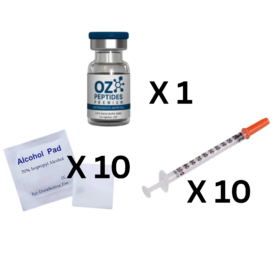 Starter Pack
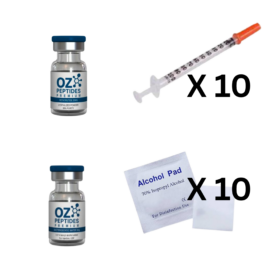 Retatrutide Starter Bundle
 5-Amino-1MQ Dosage Guide (5mg)
Peptide Guides
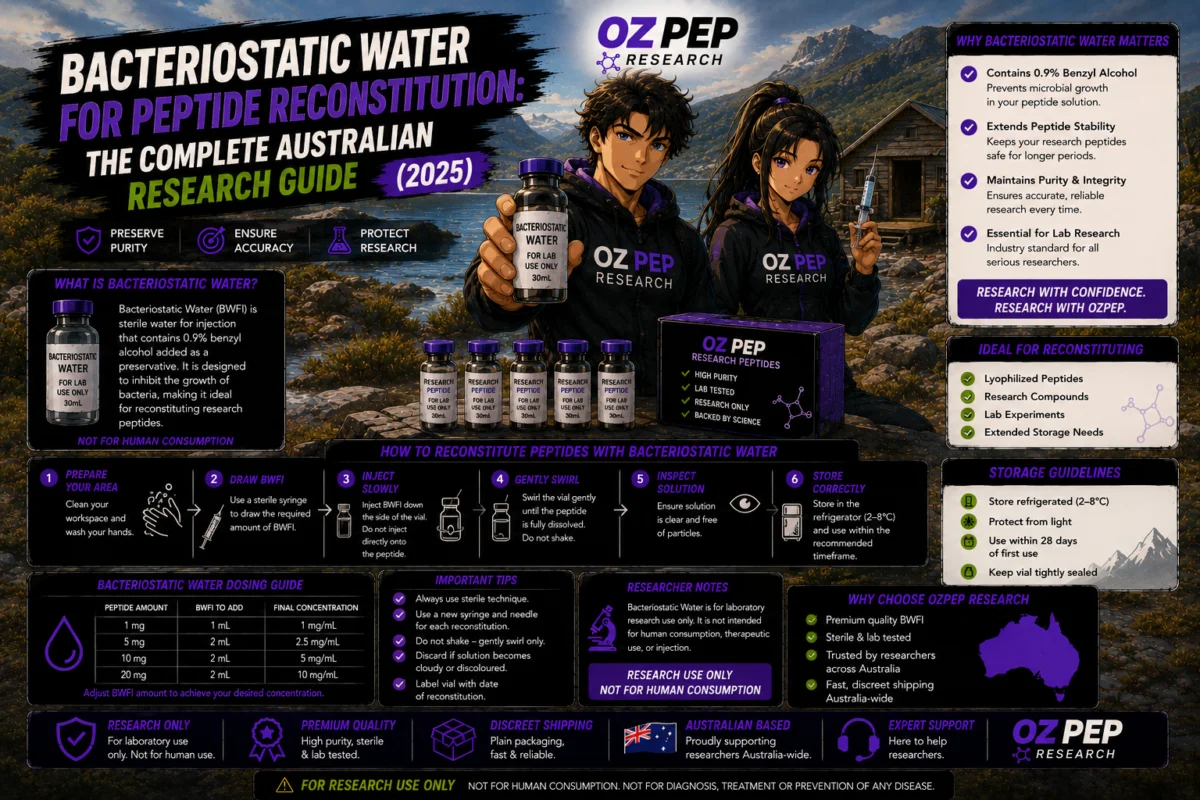
Bacteriostatic Water for Peptide Reconstitution: The Complete Australian Research Guide (2026)
Key Takeaways
- bacteriostatic water for peptide reconstitution (BAC water) is the industry-standard diluent for reconstituting lyophilised research peptides, containing 0.9% benzyl alcohol as a preservative that prevents bacterial growth in multi-dose vials.
- BAC water extends reconstituted peptide shelf life from hours (sterile water) to 28 days, making it essential for any research protocol requiring multiple administrations from a single vial.
- The pH of BAC water (~5.7) is optimised for peptide solubility and stability — neutral pH sterile water can cause precipitation or reduced solubility with certain peptide sequences.
- Sterile water lacks preservatives and is suitable only for immediate single-use applications; using it for multi-dose access introduces bacterial contamination within hours.
- Once opened, BAC water vials remain stable for 28 days when stored at 2-8°C — clearly label opening dates and discard after this period.
What Is Bacteriostatic Water?
bacteriostatic water for peptide reconstitution, commonly referred to as BAC water, is sterile water containing 0.9% (v/v) benzyl alcohol as an antimicrobial preservative. It is the standard diluent used throughout pharmaceutical and research settings for dissolving (reconstituting) lyophilised (freeze-dried) compounds — including research peptides.
The “bacteriostatic” designation is critical: benzyl alcohol inhibits bacterial growth and reproduction without necessarily killing existing organisms (“bactericidal”). This distinction means BAC water prevents the proliferation of any contaminants introduced during needle access, while remaining non-pyrogenic and suitable for research applications.
For Australian peptide researchers, understanding BAC water properties — and why it differs from alternatives — is fundamental to maintaining compound integrity, experimental reproducibility, and laboratory safety.
Why BAC Water Is Essential for Peptide Reconstitution
The Preservative Advantage: Benzyl Alcohol
The 0.9% benzyl alcohol content is what distinguishes BAC water and makes it indispensable for peptide research:
Antimicrobial Mechanism Benzyl alcohol disrupts bacterial cell membranes and inhibits cellular respiration at the cytochrome oxidase level. At 0.9% concentration, it is effective against: – Staphylococcus aureus – Escherichia coli – Pseudomonas aeruginosa – Candida albicans (yeast) – Common environmental contaminants
Multi-Dose Vial Protection Every time a needle pierces a vial septum, microscopic contaminants can be introduced. Without a preservative, these organisms multiply exponentially in the nutrient-rich aqueous environment. BAC water maintains sterility through repeated access over the 28-day usage period.
Shelf Life Extension The practical impact is dramatic:
| Diluent Type | Reconstituted Peptide Shelf Life | Multi-Dose Capability |
| Bacteriostatic Water | Up to 28 days | Yes — repeated access |
| Sterile Water | 4-8 hours | No — single use only |
| Sodium Chloride 0.9% | 24 hours | Limited |
pH Optimisation for Peptide Stability
Bacteriostatic water for peptide reconstitution is formulated to a pH of approximately 5.5-6.0 (typically ~5.7), slightly acidic compared to neutral sterile water (pH 7.0). This matters because:
- Many peptides exhibit optimal solubility in mildly acidic conditions
- Slightly acidic pH reduces hydrolytic degradation of peptide bonds
- Some peptides precipitate at neutral or alkaline pH
- The acidic environment complements the antimicrobial action of benzyl alcohol
For sequences rich in acidic amino acids (Asp, Glu) or those with specific conformational requirements, BAC water’s pH profile often produces superior dissolution characteristics compared to neutral alternatives.
Osmolality Considerations
BAC water is non-pyrogenic and iso-osmotic with body fluids, meaning it will not cause osmotic stress to cells or tissues in biological assays. This is particularly relevant for: – Cell culture applications involving peptide treatment – Tissue-based assays – In vitro studies where osmotic conditions must be controlled
BAC Water vs Sterile Water: The Critical Differences
Understanding when each type is appropriate prevents costly experimental errors:
| Feature | Bacteriostatic Water | Sterile Water for Injection |
| Preservative | 0.9% benzyl alcohol | None |
| Antimicrobial action | Bacteriostatic (prevents growth) | None |
| Multi-dose suitability | Yes — 28-day window | No — single use |
| pH | ~5.7 (acidic) | ~7.0 (neutral) |
| Shelf life (opened) | 28 days refrigerated | Discard after single use |
| Primary application | Multi-dose peptide vials | Immediate single-use reconstitution |
| Research suitability | Standard for most protocols | Emergency backup only |
| Cost | Moderately higher | Lower |
When to Use Sterile Water Instead
Despite BAC water’s advantages, there are limited scenarios where sterile water is preferred:
- Benzyl alcohol sensitivity studies — If your assay specifically tests for effects of preservatives
- Cell culture with preservative-sensitive lines — Some primary cell cultures show reduced viability with benzyl alcohol exposure (rare)
- Immediate single-use with no storage — When the entire vial will be consumed within hours
- Regulatory or protocol-specific requirements — Certain standardised assays mandate preservative-free diluents
For 99% of peptide research applications, BAC water is the correct and recommended choice.
How to Reconstitute Peptides with BAC Water: Step-by-Step Protocol
Materials Required
- Lyophilised peptide vial
- Bacteriostatic Water vial
- Alcohol swabs (70% isopropyl)
- Sterile syringes (appropriate volume)
- Sterile needles (typically 25G for reconstitution)
- Sharps disposal container
- Laboratory notebook for documentation
Reconstitution Procedure
Step 1: Calculate Your Dilution
Determine your target concentration before beginning. For example: – 5mg peptide in 2.5ml BAC water = 2mg/ml – 10mg peptide in 2ml BAC water = 5mg/ml – 2mg peptide in 1ml BAC water = 2mg/ml
Use whole-number or easily divisible volumes to simplify subsequent dosing calculations.
Step 2: Temperature Equilibration
Remove the lyophilised peptide vial from the freezer and allow it to reach room temperature while still sealed. This prevents condensation from forming inside the vial when you open it, which can compromise peptide integrity.
Step 3: Sanitise Vial Septums
Wipe both the peptide vial septum and BAC water vial septum with fresh alcohol swabs. Allow to air-dry for 30 seconds — do not blow on or touch the sanitised surfaces.
Step 4: Withdraw BAC Water
Using a sterile syringe with a fresh needle: 1. Pierce the BAC water vial septum 2. Invert the vial and withdraw the calculated volume of BAC water 3. Withdraw slightly more than needed to account for dead space in the needle 4. Remove needle from BAC water vial
Step 5: Transfer to Peptide Vial
- Pierce the peptide vial septum with the loaded syringe
- Inject BAC water slowly down the inner glass wall of the vial — never spray directly onto the lyophilised powder
- This technique minimises foaming, mechanical stress, and bubble formation that can promote peptide aggregation
- Remove needle from peptide vial
Step 6: Dissolution
- Do not shake the vial vigorously
- Allow the solution to sit undisturbed for 2-3 minutes
- Gently swirl the vial until the powder is fully dissolved
- Some peptides dissolve instantly; others may require several minutes of gentle agitation
- Do not use heat or mechanical mixing devices
Step 7: Visual Inspection
Examine the reconstituted solution: – Acceptable: Clear, colourless to faintly straw-coloured liquid – Unacceptable: Cloudiness, particles, precipitation, or unusual colour
If any abnormality is observed, discard and start fresh with a new vial.
Step 8: Documentation
Label the reconstituted vial with: – Peptide name and sequence (if applicable) – Concentration (e.g., “5mg/ml”) – Reconstitution date – Expiry date (reconstitution date + 28 days) – Researcher’s initials
Store immediately at 2-8°C.
Storage Requirements for BAC Water
Unopened BAC Water
| Parameter | Requirement |
| Temperature | Room temperature (15-30°C) or refrigerated (2-8°C) |
| Light exposure | Protected from direct light |
| Shelf life | As indicated on manufacturer’s label (typically 1-2 years) |
| Container integrity | Intact seal, undamaged vial |
Opened BAC Water
| Parameter | Requirement |
| Temperature | 2-8°C (refrigerated) |
| Maximum use period | 28 days after first puncture |
| Light exposure | Protected from light |
| Label requirement | Date of first opening clearly marked |
| Disposal | Discard after 28 days regardless of remaining volume |
The 28-day limit is non-negotiable. Beyond this period, benzyl alcohol concentration may drop below effective preservative levels, and cumulative contamination from repeated needle access increases infection risk.
Where to Source Bacteriostatic water for peptide reconstitution in Australia
Domestic Suppliers
Australian researchers should prioritise domestic sourcing for several reasons:
- Regulatory compliance — Australian-supplied BAC water meets TGA quality standards
- No import delays — Immediate availability without customs processing
- Cold-chain integrity — Domestic shipping maintains product quality
- Documentation — Australian suppliers provide compliant certificates of analysis
- Support — Local customer service for technical questions
Quality Standards to Verify
When selecting a BAC water supplier, confirm:
- TGA registration or compliance with AS 2342 (Water for Injection standards)
- Sterility certification — Passing USP <71> or equivalent sterility testing
- Endotoxin testing — <0.25 EU/ml (USP <85> LAL test)
- Benzyl alcohol concentration — 0.9% (w/v) verification
- pH testing — Within 5.5-6.0 range
- Packaging — Sealed, pyrogen-free containers with intact seals
Available Vial Sizes
bacteriostatic water for peptide reconstitution is typically available in: – 3ml single dose vials, 10ml multi-dose vials — suitable for reconstituting 2-4 peptide vials – 30ml multi-dose vials — economical for laboratories processing larger quantities
Cost Considerations
BAC water is a relatively low-cost reagent compared to research peptides themselves. The cost of a failed experiment due to contamination far exceeds any price difference between BAC water and sterile water. Consider BAC water non-negotiable insurance for your research investment.
Frequently Asked Questions
What is bacteriostatic water?
Bacteriostatic Water (BAC water) is sterile water containing 0.9% benzyl alcohol as an antimicrobial preservative. It is the standard diluent for reconstituting lyophilised research peptides because it prevents bacterial growth in multi-dose vials, extending shelf life from hours to 28 days.
Can you use sterile water instead of bacteriostatic water for peptides?
Sterile water should only be used when the entire reconstituted vial will be consumed within hours. For any protocol requiring multiple accesses or storage beyond a single day, BAC water is essential. Sterile water lacks preservatives and bacterial contamination will proliferate rapidly.
How long does BAC water last once opened?
An opened BAC water vial remains usable for 28 days when stored at 2-8°C. After 28 days, discard the vial regardless of how much remains. Always label the vial with the opening date and calculate the discard date.
What does the benzyl alcohol in bacteriostatic water do?
Benzyl alcohol at 0.9% concentration acts as a bacteriostatic agent — it inhibits bacterial growth and reproduction by disrupting cell membranes and interfering with cellular respiration. This prevents contamination during repeated needle access while remaining compatible with peptide stability.
Is bacteriostatic water safe for research use?
Yes, bacteriostatic water is manufactured to pharmaceutical-grade standards including sterility, non-pyrogenicity, and controlled benzyl alcohol concentration. It is widely used in clinical and research settings globally. Always use laboratory-grade BAC water from verified suppliers, never homemade solutions.
Where can researchers buy bacteriostatic water in Australia?
Australian researchers can source BAC water from compliant domestic research supply companies that provide TGA-standard products with certificates of analysis. Look for suppliers specialising in peptide research reagents who can verify sterility, endotoxin levels, and benzyl alcohol concentration.
What happens if I use expired BAC water?
Expired BAC water may have reduced benzyl alcohol effectiveness and increased contamination risk. The consequences include peptide degradation from bacterial proteases, introduction of endotoxins that confound biological assays, and invalid experimental results. Always discard BAC water after 28 days of opening.
Can I make my own bacteriostatic water?
No. Homemade BAC water cannot achieve pharmaceutical-grade sterility, precise benzyl alcohol concentration, or non-pyrogenic status. Contaminated or incorrectly formulated diluent will destroy your peptide investment and compromise research validity. Always purchase laboratory-grade BAC water from verified suppliers.
Does BAC water affect peptide stability?
BAC water is formulated to support peptide stability through its mildly acidic pH (~5.7), which optimises solubility and reduces hydrolytic degradation. The 0.9% benzyl alcohol concentration has been validated as non-interfering with peptide structure across thousands of research applications.
How much BAC water should I use to reconstitute a peptide?
The volume depends on your desired concentration. Divide the total milligrams of peptide by your target concentration (mg/ml) to determine the BAC water volume. For example: 5mg peptide ÷ 2mg/ml target = 2.5ml BAC water. Choose concentrations that make your dosing calculations simple and precise.
Conclusion and Next Steps
Bacteriostatic water for peptide reconstitution is the unsung hero of peptide research — a seemingly simple reagent that fundamentally determines whether your expensive peptides remain stable and your experiments produce valid data. The 0.9% benzyl alcohol preservative transforms reconstituted peptide shelf life from hours to 28 days, while the optimised pH supports solubility and structural integrity.
For Australian researchers, the message is clear: use BAC water as your standard diluent for all multi-dose peptide protocols, verify supplier quality standards, and rigorously adhere to the 28-day discard rule for opened vials.
Ready to reconstitute your peptides? Review our complete guide to peptide storage to ensure your reconstituted compounds remain stable throughout your research protocol, and explore our DSIP research guide for an example of how proper reconstitution supports valid experimental outcomes.
References & Outbound Links
- USP-NF. Bacteriostatic Water for Injection official monograph. United States Pharmacopeia-National Formulary. https://www.uspnf.com/
- World Health Organization (WHO). Recommendations on the transport of dangerous goods — Model Regulations 2023. Biological substances and aqueous solutions. https://unece.org/transport/standards/transport/dangerous-goods/rev-23-model-regulations
- Therapeutic Goods Administration (TGA). Australian Standard AS 2342: Water for Injection. 2022. https://www.tga.gov.au/
- USP-NF. <71> Sterility Tests. United States Pharmacopeia. https://www.usp.org/
- USP-NF. <85> Bacterial Endotoxins Test. United States Pharmacopeia. https://www.usp.org/
- European Medicines Agency (EMA). Guideline on the sterilisation of the medicinal product, active substance, excipient and primary container. 2019. https://www.ema.europa.eu/en/documents/scientific-guideline/guideline-sterilisation-medicinal-product-active-substance-excipient-primary-container_en.pdf
- CDC. Guidelines for Isolation Precautions in Hospitals. Safe injection practices. 2007. https://www.cdc.gov/infectioncontrol/guidelines/isolation/
- Australian Commission on Safety and Quality in Health Care. Aseptic Technique Clinical Standard. ACSQHC, Sydney. 2022. https://www.safetyandquality.gov.au/our-work/infection-prevention-and-control
