
 Weight Loss
 Injury and Repair
 Muscle Building
 Anti-aging
 Cognitive Function
 3ml Benzyl Alcohol Bacteriostatic Water
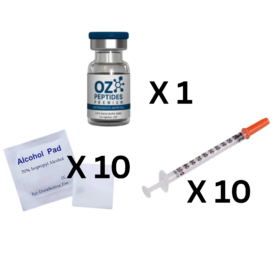 Starter Pack
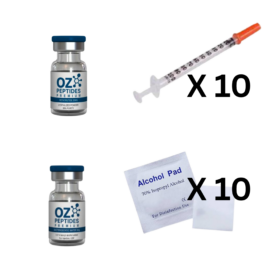 Retatrutide Starter Bundle
 5-Amino-1MQ Dosage Guide (5mg)
Peptide Guides
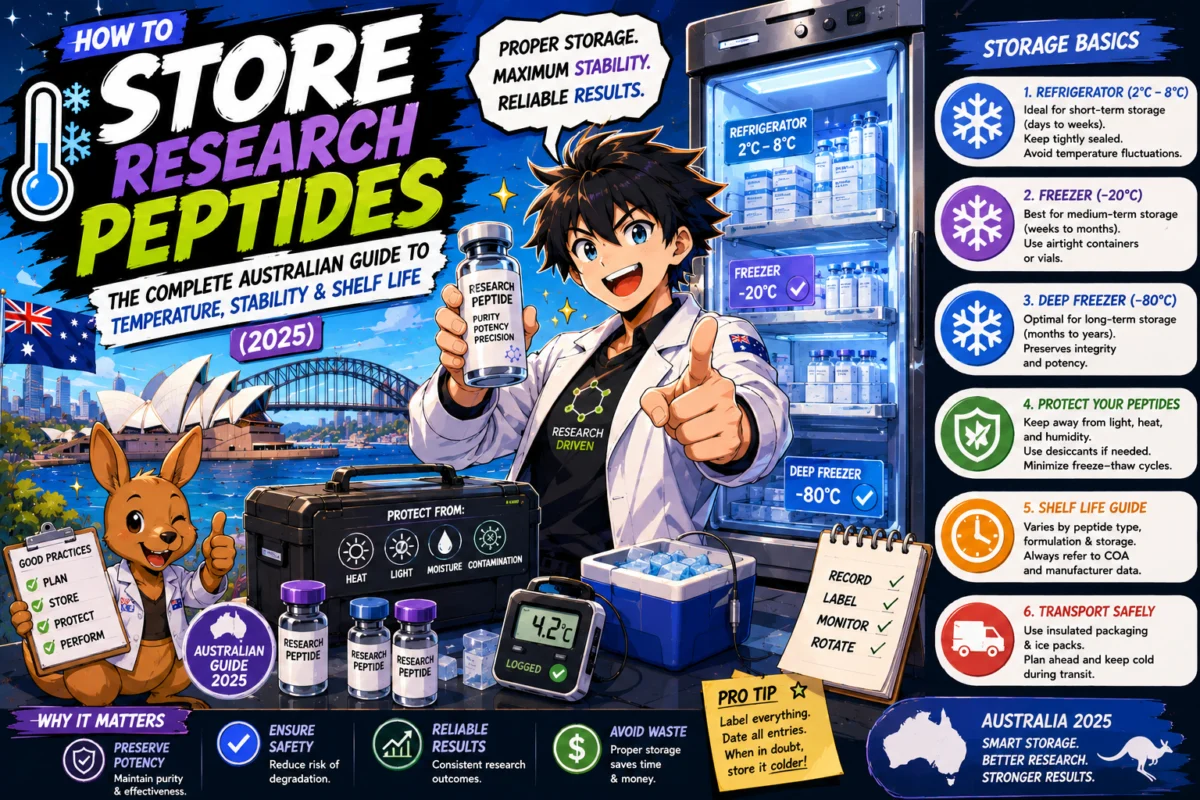
How to Store Research Peptides: The Complete Australian Guide to Temperature, Stability & Shelf Life (2025)
Key Takeaways
- Lyophilised (freeze-dried) peptides stored at -20°C in sealed, light-protected vials remain stable for 24+ months — this is the gold standard for long-term storage.
- Reconstituted peptides must be stored at 2-8°C (refrigerated) and typically remain viable for up to 28 days, though some stable compounds may last longer depending on sequence and solvent.
- Never subject reconstituted peptides to freeze-thaw cycles — crystallisation destroys secondary structure and aggregation renders compounds unusable for research.
- Bacteriostatic water (0.9% benzyl alcohol) is the recommended diluent for reconstitution; sterile water lacks preservatives and limits shelf life to single-use applications.
- Australian researchers must account for transport heat exposure during domestic shipping, particularly for interstate deliveries during summer months.
Why Proper Peptide Storage Matters
Peptide stability is not merely a logistical concern — it is a fundamental determinant of research validity. A degraded peptide can produce false negatives, inconsistent dose-response curves, and irreproducible results that compromise entire study protocols.
Research peptides are inherently fragile molecules. Their biological activity depends on precise three-dimensional conformations maintained by hydrogen bonds, disulfide bridges, and hydrophobic interactions. Disruption of these structures through improper temperature, light exposure, pH shifts, or microbial contamination renders the compound useless — and potentially introduces confounding variables into your research.
For Australian researchers operating in climates ranging from tropical (Darwin, Cairns) to temperate (Melbourne, Hobart) to arid (Alice Springs, Perth), environmental conditions present unique challenges that demand rigorous storage protocols.
Understanding Peptide Degradation Pathways
Before diving into storage protocols, understanding how peptides degrade helps researchers appreciate why each requirement exists:
1. Hydrolytic Degradation
Water molecules attack peptide bonds between amino acids, cleaving the chain. This is the primary degradation pathway for reconstituted peptides and explains why lyophilisation dramatically extends shelf life by removing the water required for hydrolysis.
2. Oxidation
Methionine, cysteine, tryptophan, and tyrosine residues are particularly susceptible to oxidation. Exposure to oxygen and light accelerates this process, altering peptide structure and potentially creating immunogenic aggregates.
3. Aggregation
Peptides can self-assemble into insoluble aggregates through hydrophobic interactions or beta-sheet formation. This is especially problematic for amyloidogenic sequences and long-chain peptides. Aggregation is irreversible and renders compounds unsuitable for research.
4. Microbial Contamination
Bacterial and fungal growth in reconstituted solutions produces proteases that digest peptide chains. This is why bacteriostatic water — with its 0.9% benzyl alcohol preservative — is essential for multi-dose vials.
5. Temperature-Induced Denaturation
Excessive heat disrupts secondary and tertiary structures. While most peptides tolerate brief room-temperature exposure, sustained heat above 25°C accelerates all degradation pathways simultaneously.
Lyophilised Peptide Storage: The Gold Standard
What Is Lyophilisation?
Lyophilisation (freeze-drying) removes water from peptide solutions through sublimation — converting ice directly to vapour under vacuum. The resulting fluffy white powder is chemically stable, lightweight, and resistant to degradation for extended periods.
Optimal Storage Conditions for Lyophilised Peptides
| Parameter | Requirement | Rationale |
| Temperature | -20°C (standard freezer) | Minimises all chemical degradation pathways |
| Container | Original sealed vial | Prevents moisture absorption and oxidation |
| Light exposure | Complete darkness | Prevents photo-oxidation of sensitive residues |
| Atmosphere | Inert gas (argon/nitrogen) headspace | Reduces oxidative degradation |
| Humidity | Dry environment | Prevents moisture absorption by hygroscopic powder |
Shelf Life of Lyophilised Peptides
Under optimal conditions (-20°C, sealed, light-protected): – Standard stability: 24 months minimum – Extended stability: 36+ months for robust sequences – Conservative estimate: 12 months for peptides with oxidation-sensitive residues
Most Australian research peptide suppliers provide COA-dated stability data specific to each lot. Always check the manufacturer’s stability documentation rather than applying blanket rules.
Special Considerations for Long-Term Storage
- Avoid frost-free freezers — The heating cycles that prevent frost buildup create temperature fluctuations that stress peptide stability. Use manual-defrost freezers for long-term peptide storage.
- Desiccant packs — Including silica gel desiccants in storage containers provides additional protection against moisture, particularly important in Australia’s humid coastal regions.
- Amber or opaque wrapping — If original packaging is transparent, wrap vials in aluminium foil or store in opaque containers to eliminate light exposure during freezer access.
- Label durability — Use cryogenic-resistant labels; standard paper labels degrade and fall off in freezer conditions, creating identification risks.
Reconstituted Peptide Storage
The Reconstitution Process
Reconstitution transforms lyophilised powder into a liquid solution suitable for research applications. The choice of diluent and technique directly impacts stability:
Recommended diluent: Bacteriostatic Water (BAC water) containing 0.9% benzyl alcohol – Prevents bacterial growth in multi-dose vials – Extends shelf life from hours to weeks – pH optimised for peptide solubility
Alternative (single-use only): Sterile Water for Injection – No preservative — bacterial growth begins immediately upon opening – Must be used within hours of reconstitution – Suitable only for protocols requiring immediate consumption of entire vial contents
Step-by-Step Reconstitution Protocol
- Remove lyophilised vial from freezer and allow to reach room temperature still sealed (prevents condensation inside vial)
- Wipe both the peptide vial septum and BAC water vial septum with alcohol swabs
- Using a sterile syringe, withdraw the calculated volume of bacteriostatic water
- Inject BAC water slowly down the inner wall of the peptide vial — do not spray directly onto the powder (minimises foaming and mechanical stress)
- Allow the vial to sit undisturbed for several minutes, then gently swirl — never shake vigorously (shaking can cause aggregation through mechanical shear)
- Verify complete dissolution; do not use if particulate matter remains
- Label with reconstitution date, peptide name, concentration, and expiry
Storage Requirements for Reconstituted Solutions
| Parameter | Requirement |
| Temperature | 2-8°C (standard refrigerator) |
| Light exposure | Protected from light (foil wrap or amber vial) |
| Container | Original vial with intact septum seal |
| Typical shelf life | Up to 28 days (varies by peptide) |
| Maximum recommended | 30 days conservative limit |
Critical Warning: No Freeze-Thaw Cycles
Never freeze reconstituted peptides. When aqueous peptide solutions freeze, ice crystal formation creates mechanical stress that:
- Disrupts secondary and tertiary structures
- Promotes aggregation through concentration effects at ice crystal interfaces
- Can cause irreversible precipitation
- Generates pH shifts as buffer components crystallise at different temperatures
If you require long-term storage of reconstituted material, the correct approach is aliquotting — dividing into single-use volumes before freezing, or (preferably) storing remaining lyophilised powder and reconstituting fresh as needed.
Bacteriostatic Water vs Sterile Water: Storage Implications
| Feature | Bacteriostatic Water | Sterile Water |
| Preservative | 0.9% benzyl alcohol | None |
| Reconstituted shelf life | Up to 28 days | Hours (single use) |
| Multi-dose capability | Yes | No |
| pH | ~5.7 (acidic, optimised) | ~7.0 (neutral) |
| Bacterial growth prevention | Active | None |
| Best for | All multi-use research protocols | Immediate single-use only |
For any research protocol requiring multiple administrations from a single vial, bacteriostatic water is not optional — it is essential. The extended shelf life it provides is critical for study validity; a contaminated vial introduces bacterial endotoxins and proteolytic enzymes that compromise both peptide integrity and research outcomes.
[Internal Link: Read our complete guide to bacteriostatic water for peptide reconstitution]
Transport and Shipping Considerations for Australian Researchers
Australia’s geography presents unique challenges for peptide logistics:
Domestic Shipping
- Interstate express post: 1-3 business days depending on origin/destination
- Temperature exposure risk: Highest during summer months (December-February) and for north-south routes
- Recommended: Insulated packaging for all peptide shipments, even lyophilised powder
- Receipt protocol: Inspect immediately upon delivery.
Regional and Remote Delivery
Researchers in regional Queensland, Northern Territory, Western Australia, and Tasmania face extended transit times: – Allow additional buffer time for delivery – Coordinate shipping to avoid weekend warehouse holds – Consider establishing local backup supply relationships – Track shipments actively and arrange prompt collection from delivery points
International Importation
Personal importation of research peptides is prohibited under Australian Customs regulations. Licensed institutions must: – Hold appropriate permits for Schedule 4/9 substances – Work with suppliers experienced in Australian import documentation – Allow extended processing time for customs clearance – Maintain all importation records for regulatory compliance
Storage Environment Checklist for Australian Laboratories
Freezer Requirements
- ☐ Manual defrost (not frost-free) preferred
- ☐ Temperature monitoring with daily logging
- ☐ Backup power or contingency plan for outages
- ☐ Organised inventory system with location mapping
- ☐ Restricted access to prevent unnecessary door opening
Refrigerator Requirements
- ☐ Dedicated peptide refrigerator (not shared with food/samples)
- ☐ Stable 2-8°C verified with calibrated thermometer
- ☐ Internal fan for temperature uniformity
- ☐ Glass door or internal light (minimise opening time)
- ☐ Temperature alarm for out-of-range events
General Laboratory
- ☐ Dark storage cabinet for light-sensitive materials
- ☐ Desiccant supplies for humidity control
- ☐ Cryogenic labels and permanent markers
- ☐ Reconstitution logbook or electronic tracking system
- ☐ Alcohol swabs, sterile syringes, sharps disposal
Signs of Peptide Degradation
Researchers should visually inspect peptides before each use. Discard if you observe:
| Sign | Likely Cause | Action |
| Cloudiness/precipitation in solution | Aggregation or microbial growth | Discard immediately |
| Colour change (yellowing/browning) | Oxidation or Maillard reaction | Discard |
| Particulate matter | Aggregation or contamination | Discard |
| Failure to dissolve completely | Pre-existing aggregation | Do not force; discard |
| Unusual odour | Bacterial contamination | Discard |
| Septum damage or leakage | Compromised sterility | Discard |
When in doubt, discard and reconstitute fresh from lyophilised stock. The cost of a replacement vial is negligible compared to compromised research data.
Frequently Asked Questions
How should research peptides be stored?
Research peptides should be stored lyophilised at -20°C in sealed, light-protected vials for long-term stability. Once reconstituted with bacteriostatic water, store at 2-8°C (refrigerated) and use within 28 days. Always protect from light and avoid temperature fluctuations.
How long do peptides last once reconstituted?
Most reconstituted peptides remain stable for up to 28 days when stored at 2-8°C with bacteriostatic water as the diluent. Some robust sequences may last longer, but 28 days is the conservative standard for research applications. With sterile water (no preservative), shelf life reduces to hours.
What happens if peptides are not stored properly?
Improper storage accelerates degradation through hydrolysis, oxidation, aggregation, and microbial contamination. Signs include cloudiness, precipitation, colour change, and loss of biological activity in assays. Degraded peptides produce unreliable research data and should be discarded.
Can you refreeze reconstituted peptides?
No. Freeze-thaw cycles cause ice crystal formation that destroys peptide secondary structure and promotes irreversible aggregation. If long-term frozen storage of liquid is necessary, aliquot into single-use volumes before the initial freeze — never refreeze thawed material.
What is the difference between lyophilised and reconstituted peptide storage?
Lyophilised (freeze-dried) peptides are powder form with water removed, making them chemically stable at -20°C for 24+ months. Reconstituted peptides are dissolved in liquid (typically bacteriostatic water), which enables hydrolytic degradation and requires refrigeration at 2-8°C with a 28-day shelf life.
Should I use bacteriostatic water or sterile water for reconstitution?
Use bacteriostatic water for any protocol requiring multi-dose access over time. The 0.9% benzyl alcohol prevents bacterial growth and extends shelf life to 28 days. Sterile water lacks preservatives and is suitable only for immediate single-use applications.
Do Australian climate conditions affect peptide storage?
Yes. Australia’s high summer temperatures and humidity in coastal regions increase degradation risk during transport and storage. Always use insulated shipping with cold packs, maintain climate-controlled laboratory environments, and minimise exposure time when accessing refrigerated or frozen materials.
Conclusion and Next Steps
Proper storage is the foundation of valid peptide research. Lyophilised peptides at -20°C offer 24+ months of stability, while reconstituted solutions require careful refrigeration at 2-8°C with a 28-day usage window. The single most damaging mistake researchers make is subjecting reconstituted peptides to freeze-thaw cycles — a practice that renders compounds unusable.
For Australian researchers, investing in appropriate storage infrastructure (manual-defrost freezers, dedicated refrigerators, temperature monitoring) and rigorous protocols pays dividends through preserved compound integrity and reproducible research outcomes.
Planning to reconstitute your peptides? Read our comprehensive guide to bacteriostatic water to ensure you’re using the correct diluent and technique for maximum compound stability.
References & Further Reading
- Pearlman R, Bogard WC Jr. Stability of Peptide Pharmaceuticals. In: Pharmaceutical Biotechnology. Springer, 2019:145-177. https://link.springer.com/chapter/10.1007/978-3-030-00710-2_6
- Manning MC, Chou DK, Murphy BM, et al. Stability of Protein Pharmaceuticals: An Update. Pharmaceutical Research. 2010;27(4):544-575. https://pubmed.ncbi.nlm.nih.gov/20143256/
- Koski LB, Tatsuo M, Touma M. Stability of peptides in storage: recommendations based on a systematic analysis. Journal of Peptide Science. 2012;18(11):707-713. https://pubmed.ncbi.nlm.nih.gov/23059836/
- Breen L, Paciulli D, Morgan M, et al. Effect of Freezing and Thawing on Peptide Stability in Biological Samples. Bioanalysis. 2018;10(14):1065-1077. https://pubmed.ncbi.nlm.nih.gov/29958011/
- World Health Organization (WHO). Good Storage and Distribution Practices for Pharmaceutical Products. WHO Technical Report Series. 2024. https://www.who.int/publications/m/item/trs-1065
- TGA. Guidelines on Storage Conditions for Therapeutic Goods. Australian Government. 2024. https://www.tga.gov.au/resources/guidance/guidelines-storage-conditions-therapeutic-goods
- International Conference on Harmonisation (ICH). Q1A(R2) Stability Testing of New Drug Substances and Products. https://database.ich.org/sites/default/files/Q1A%28R2%29%20Guideline.pdf
